Virginia's Corporate Land Use Choices Under Shifting State Gambling Regulations
Zara Butler · Jun 23, 2026
Virginia's Corporate Land Use Choices Under Shifting State Gambling Regulations
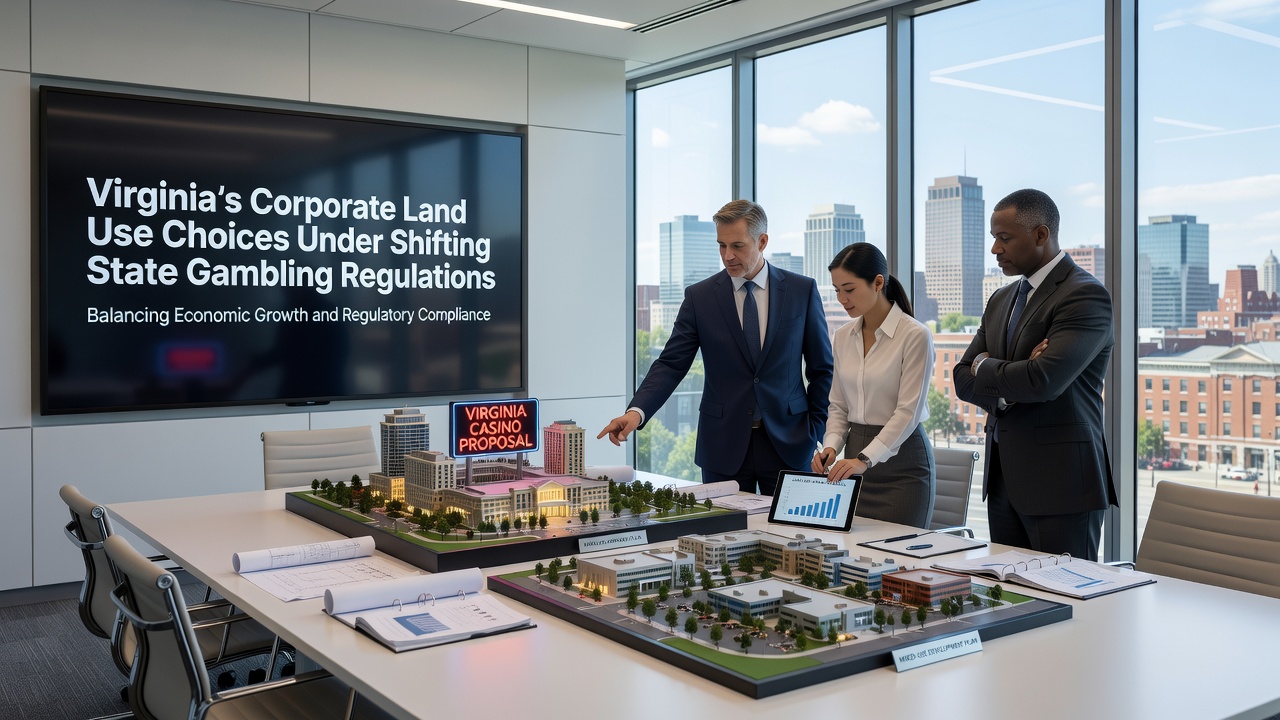
Virginia has seen its gambling framework evolve through legislative adjustments that directly influence how corporations evaluate land parcels for gaming facilities. State lawmakers passed expanded gaming measures in 2020 that authorized up to five casinos alongside sports betting and historical horse racing terminals, yet subsequent regulatory refinements have altered zoning considerations and site selection criteria for major operators. Companies now assess parcels based on proximity to urban centers, infrastructure capacity, and compliance with local land-use ordinances that continue to shift as new guidelines emerge. Observers note that corporate decisions hinge on the interplay between state-level approvals and municipal zoning boards. Data from the Virginia General Assembly shows multiple proposals for casino resorts stalled or redirected when local governments updated their comprehensive plans to restrict gaming-adjacent commercial development. Those who've tracked these patterns point to examples where firms opted for mixed-use developments that incorporate retail, hospitality, and limited gaming floors rather than standalone casino structures.Regulatory Framework and Land Allocation Patterns
State statutes require prospective operators to secure both a gaming license and local voter approval before advancing land development plans. This dual-layer process forces corporations to align their real estate strategies with shifting municipal codes that address traffic flow, water usage, and environmental impact studies. Figures released by the Virginia Department of Planning and Budget indicate that approved projects often occupy former industrial zones reclassified for entertainment purposes, while greenfield sites face heightened scrutiny under updated stormwater management rules.
What's interesting is how these regulations create incentives for adaptive reuse of existing buildings. Several applicants have pursued conversions of large retail centers or convention spaces instead of new construction, reducing the footprint on undeveloped land while satisfying density requirements. Researchers at the University of Virginia's Weldon Cooper Center for Public Service have documented how such choices affect surrounding property values and tax revenue projections over multi-year periods.
Corporate Strategies in Response to 2025-2026 Updates
By early 2025, additional rule changes clarified licensing timelines and imposed stricter financial disclosures for land acquisition deals tied to gaming ventures. These adjustments prompted several firms to revise their portfolios, favoring locations near established transportation corridors where land costs align with projected returns from combined hotel and gaming operations. In June 2026, further amendments are scheduled to take effect that will require enhanced community benefit agreements, including commitments to workforce training programs and public infrastructure contributions before any ground-breaking occurs.
One study revealed that operators increasingly incorporate modular design elements into their land plans, allowing future adjustments if regulatory caps on gaming positions change. This approach appears in proposals submitted to localities in the Hampton Roads and Northern Virginia corridors, where land parcels already zoned for large-scale commercial activity provide flexibility. Industry reports from the Canadian Gaming Association note similar adaptive strategies among North American firms navigating comparable policy transitions.
Local Government Influence on Site Viability
Municipalities retain significant authority over land-use permits, and many have introduced overlay districts that either facilitate or constrain gaming developments. Evidence suggests these districts often prioritize economic revitalization goals while imposing design standards that integrate new facilities with existing neighborhoods. According to records from the Virginia Association of Counties, several jurisdictions have negotiated revenue-sharing models that tie gaming tax proceeds to specific land improvements such as road expansions or park enhancements.
Turns out the emphasis on these agreements has led some corporations to acquire larger tracts than initially planned, creating buffer zones that address noise and visual impact concerns raised during public hearings. Data shows this tactic has expedited approvals in areas where prior standalone casino applications encountered resistance.
Conclusion
Virginia's evolving gambling regulations continue to shape corporate land-use decisions through a combination of state licensing requirements, local zoning authority, and scheduled policy updates through 2026. Companies respond by selecting parcels that balance regulatory compliance with operational efficiency, often favoring adaptive reuse and mixed-use configurations. These patterns reflect ongoing adjustments as operators and localities navigate the intersection of gaming expansion and land management priorities.